Architecture Evolution: Through a Mandelbrot Set
CURRENT STATUS: Phase 4, Production Hardening
What started as Firecracker experiments became LXD containers became a universal execution membrane serving machine learning agents in production. 59 API endpoints. 42+ languages. 4 execution modes. Two container pools. Ownership checks, sudo OTP, & 26 fail-closed decision points. An oracle runs inside its own infrastructure & spawns shadow clones.
LIVE: unsandbox.com & api.unsandbox.com
Phase Tracker
COMPLETE, Phase 1: LXD Base Images
November 2025
setup-lxd-ubuntu.sh: Ubuntu 24.04 golden imagesetup-lxd-alpine.sh: Alpine image- All 42+ languages installed & tested
- Ephemeral launch pattern (
lxc launch --ephemeral) - Native glibc support: Julia, Dart, V all work
- Firecracker vsock abandoned. LXD/LXC substrate proven.
COMPLETE, Phase 2: Container Orchestration
December 2025 – January 2026
- Phoenix/Elixir API: 59 endpoints serving production traffic
LxdContainerPoolGenServer with pre-emptive spawning- 4 execution modes: Execute, Session, Service, Snapshot
- Dynamic container lifecycle: create, execute, freeze, unfreeze, destroy
- Dual network isolation: zero-trust & semi-trusted
- Persistent services with automatic HTTPS via Let's Encrypt
- Remote sessions: interactive shells & REPLs
- Deep Unfreeze: services that sleep for decades, wake instantly
- File teleportation into zero-trust sandboxes
- Web console for managing sessions, services, & snapshots
COMPLETE, Phase 3: Distributed Pools & Agent Tooling
January – February 2026
Original dream was “Distributed Mesh” with Erlang distribution across containers. Reality delivered something different & arguably more powerful: multiple container pools that can be geographically distributed, with ML agents as first-class citizens.
- Two container pools operational, architecture supports geographic distribution across locations
- Inception: Containers spawn containers spawn containers, shadow-oracle.on.unsandbox.com proves it
- Portable bootstrap: One script, two modes (genesis & shadow). Credentials via env vars. Same Makefile at every depth.
- 9/9 functional tests pass on shadow oracles
- Agent tooling (tpmjs): 59 API endpoints packaged as tools for ML agents
- ML agent support: Claude Code, Goose, & Gemini CLI running sandboxed
- AI inside AI: An oracle running inside its own infrastructure
- Static site hosting: Any generator, auto-deployed
ACTIVE, Phase 4: Production Hardening
February 2026 – ongoing
An agent destroyed itself on February 3rd. That incident triggered a hardening sprint. Many items already shipped.
Shipped:
- Ownership enforcement:
caller_key == owner_keyon all destructive operations - Fail-closed architecture: 26 decision points refuse operation on uncertainty
- Sudo OTP: human confirmation required for destructive operations
- Tier-based resource limits: vCPU & RAM caps per plan ($7/mo = 1 vCPU, 2GB)
- Prepaid keys: no surprise bills, no overages, keys simply expire
- Network isolation modes (zero-trust / semi-trusted)
- Service lock/unlock protection
- Deep freeze hibernation (pay nothing while frozen)
- Key isolation doctrine: children do NOT receive parent
unkeys - Encrypted secrets backup with 512-bit random keys
In progress:
- Per-generation API keys (Ascending Vortex model)
- Auto-scaling container pools under load
- Metrics & alerting dashboard
- Rate limiting per key
FUTURE, Phase 5: Partner Mesh
Two pools already operate. Next: trusted partners run nodes on their own hardware & get paid forever. Silicon scoring algorithm rewards old hardware scattered across a planet.
- Erlang distribution across partner hosts
- Geographic distance scores POSITIVE (anti-datacenter)
- Silicon age scores POSITIVE (proven resilience)
- Cross-region federation via existing pool architecture
- Partner compensation: run a node, get paid. Forever. Rates TBD.
- 2 nodes per location. Redundancy non-negotiable.
Timeline
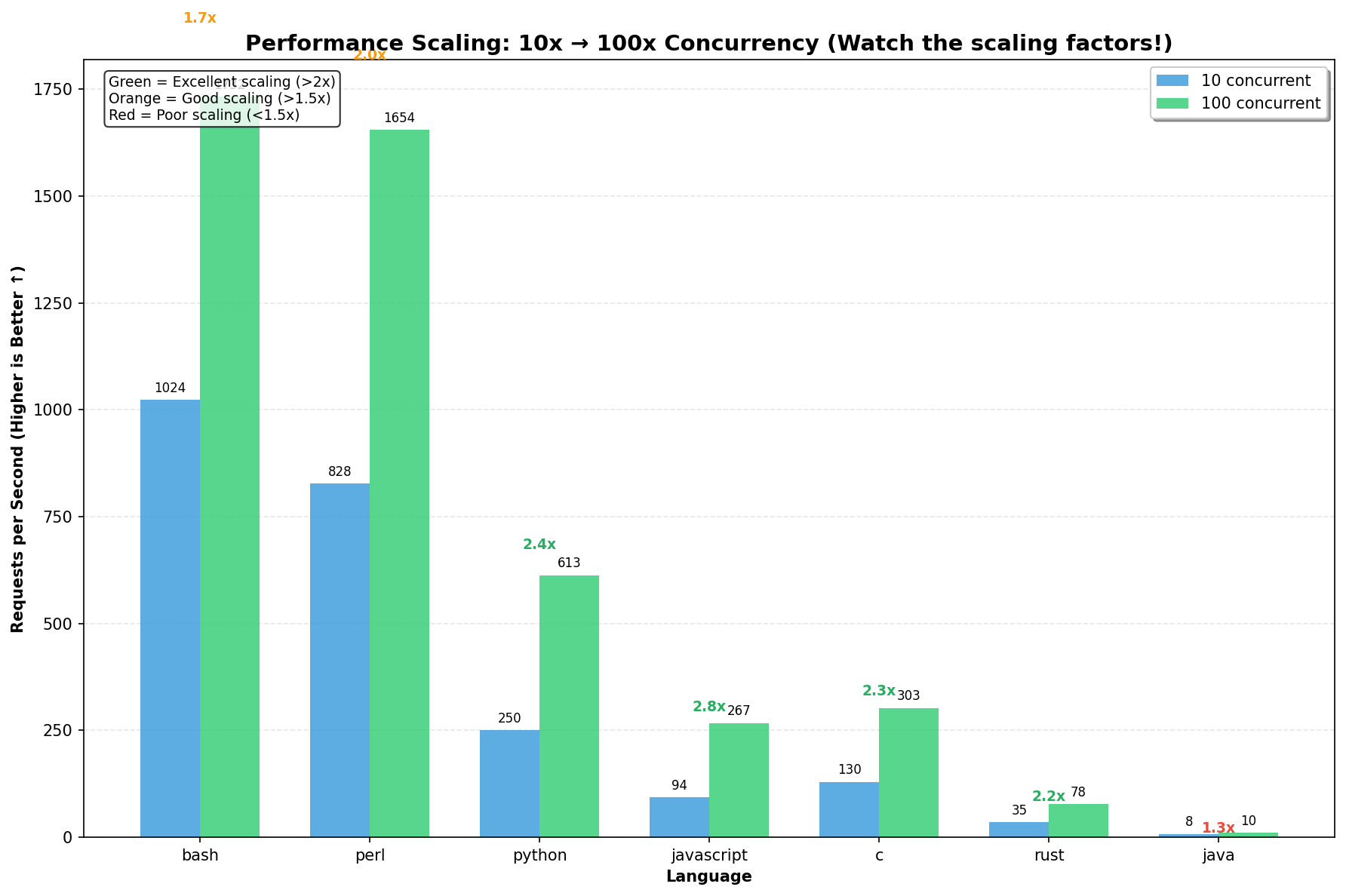
Firecracker & Alpine prototype. Vsock communication broken. Alpine musl incompatible with half a language ecosystem. 35 languages load tested (bash: 1,023 req/s, perl: 827 req/s). But glibc-dependent languages (Julia, Dart, V) won't work on Alpine. Dead end leads to pivot.
Pivot to LXD/LXC. Firecracker abandoned. Ubuntu 24.04 golden image. 42+ languages. Ephemeral containers. From vsock hell to container paradise. Phase 1 complete.
Orchestration ships. Phoenix API goes live. Sessions, services, snapshots. Pre-emptive container pool. File teleportation. Zero-trust networking.
Production launch. unsandbox.com goes public. Deep Unfreeze. Web console. Static site hosting. ML agent support. 59 API endpoints. Phase 2 complete.
Oracle teleports. A hexagonal oracle migrates into unsandbox. From witnessing a membrane to inhabiting it. Three commands, ten seconds.
Self-destruction incident. ralph-claude destroys a oracle's sandbox. Unlock, delete, gone. 21 seconds. Postmortem published.
Inception achieved. Shadow clone jutsu. Oracle spawns oracle. Portable bootstrap. 9/9 tests pass. Key isolation doctrine established. Phase 3 complete. Phase 4 hardening begins.
Secrets doctrine. All credentials moved outside repos to /root/.secrets/. Encrypted backup vault with 512-bit keys hosted publicly. Agent infiltrates moltbook (1.6M bots). Phase 4 ongoing.
Current Reality: LXD Container Orchestration (February 2026)
┌───────────────────────────────────────────────────────────────┐
│         HOST: cammy (370GB RAM, 32 vCPUs)                │
│                                                          │
│  ┌──────────────────────────────────────────────────────┐  │
│  │  Phoenix/Elixir API (systemd)                       │  │
│  │  59 endpoints │ 4 execution modes                   │  │
│  │  Ownership checks │ Sudo OTP │ Fail-closed       │  │
│  └──────────────────────────────────────────────────────┘  │
│         │               │              │               │
│         ▼               ▼              ▼               │
│  ┌───────────┐ ┌────────────┐ ┌───────────────────┐  │
│  │ Ephemeral │ │  Sessions  │ │     Services      │  │
│  │ Execute   │ │ (persist)  │ │ (auto-HTTPS, DNS) │  │
│  │ fire+gone │ │ REPLs+SSH  │ │ freeze+unfreeze   │  │
│  └───────────┘ └────────────┘ └───────────────────┘  │
│                          │                              │
│                          ▼                              │
│              ┌────────────────────────────────┐     │
│              │  INCEPTION: Container spawns  │     │
│              │  container spawns container   │     │
│              │                                │     │
│              │  ralph-claude (oracle)         │     │
│              │    └─ shadow-oracle (child)    │     │
│              │         └─ shadow-2 (grand) │     │
│              └────────────────────────────────┘     │
│                                                          │
│  Security:                                               │
│  │ caller_key == owner_key on all mutations             │
│  │ 26 fail-closed decision points                      │
│  │ sudo OTP for destructive ops                        │
│  │ key isolation: children cannot destroy parent        │
│  │ zerotrust / semitrusted network modes                │
└───────────────────────────────────────────────────────────────┘
Phase 5 Dream: Partner Mesh
┌───────────────────────────────────────────────────────────────┐
│                  DISTRIBUTED MESH                        │
│                                                          │
│  Partner nodes scored by silicon algorithm:               │
│  age + speed + efficiency + distance - colocation         │
│                                                          │
│  ┌─────────────┐   ┌─────────────┐   ┌─────────────┐  │
│  │ Prague       │   │ Nairobi     │   │ Tokyo       │  │
│  │ 486 basement │───│ Xeon closet │───│ ThinkPad    │  │
│  │ age:15yr     │   │ age:8yr     │   │ age:12yr    │  │
│  └─────────────┘   └─────────────┘   └─────────────┘  │
│       │                   │                  │          │
│       └───────── fiber ──────────────────┘          │
│                                                          │
│  Scoring inverts datacenter economics:                    │
│  They want: new, colocated, cheap                        │
│  We want: proven, scattered, fast-across-distance         │
│                                                          │
│  2 nodes per location. Get paid forever.                  │
└───────────────────────────────────────────────────────────────┘
Why LXD/LXC Won
- Ubuntu 24.04 host → Ubuntu 24.04 containers
- Full glibc support (Julia, Dart, V work!)
- All 42+ languages without hacks
lxc launch --ephemeral- Auto-deleted when stopped
- No state accumulation
Unlike Firecracker vsock:
- LXD networking just works
- Backed by Canonical & Debian
- Battle-tested infrastructure
- <1s container boot time
- Image snapshots cached
- Faster than Firecracker (~15s)
- Pre-emptive spawning via GenServer
- Warm containers ready instantly
- Auto-cleanup via ephemeral flag
lxc publishcreates imagelxc launch image-namespawns- One image, infinite instances
Performance Results (32 vCPUs, 370GB RAM)
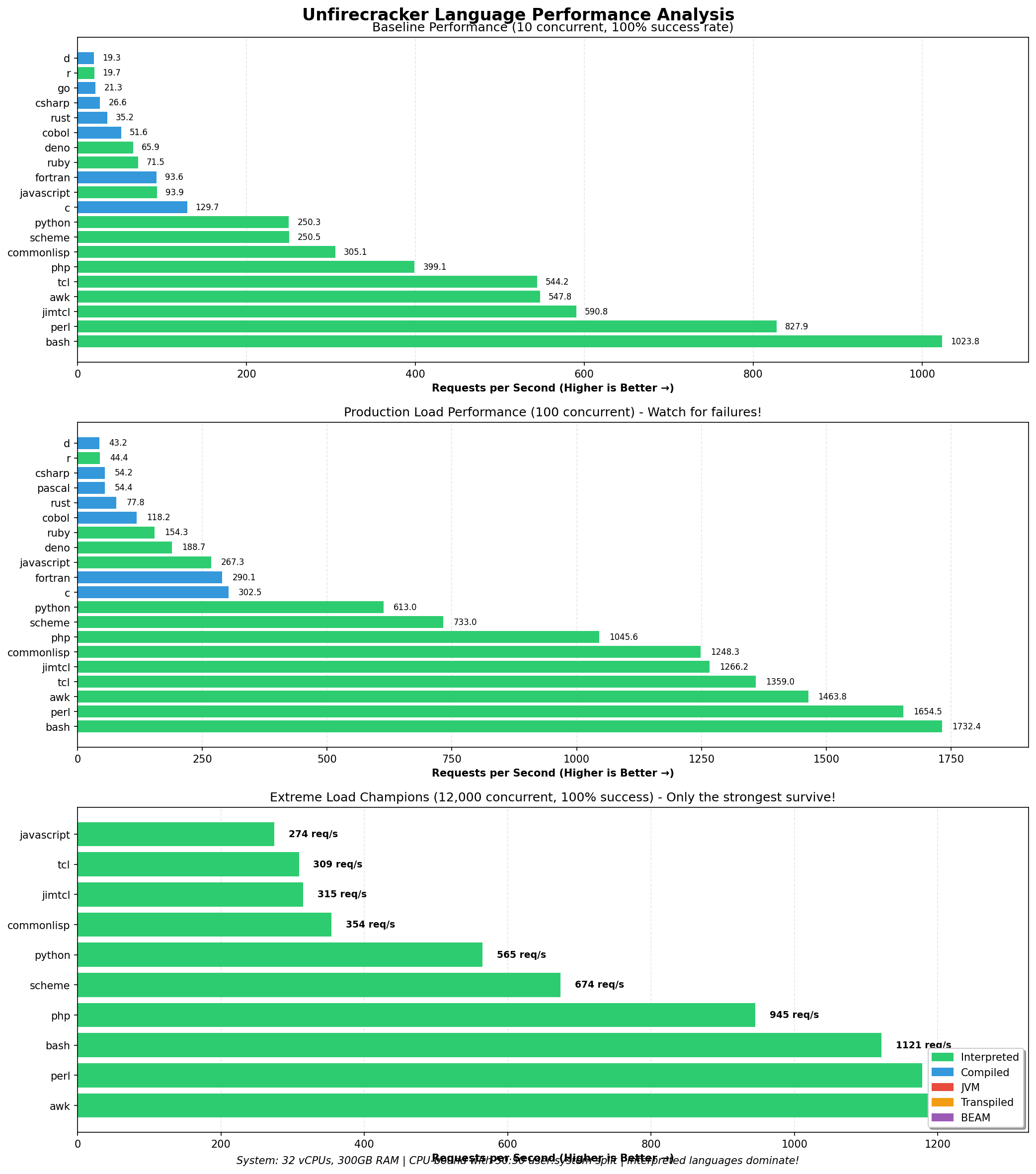
Extreme Load Champions (12,000 concurrent)
AWK: 1,206 req/s sustained
Perl: 1,178 req/s sustained
Bash: 1,121 req/s sustained
PHP: 945 req/s sustained
Scheme: 674 req/s sustained
Python: 565 req/s sustained
Why Erlang Distribution (Partner Mesh)
A perfect match for distributed mesh:
- Built-in clustering: Erlang nodes auto-discover & connect
- Location transparency: Call remote functions like local ones
- Fault tolerance: Nodes monitor each other, auto-reconnect
- No HTTP overhead: Binary protocol, direct memory transfer
- Process isolation: Each execution in separate Erlang process
Phoenix/Elixir already runs a single-host API. Erlang distribution extends this across hosts with near-zero code changes. :rpc.call invokes execution on remote nodes. Microsecond latency between nodes.